http://madamenoire.com/190101/head-woman-in-charge-crystal-travis-on-launching-world-of-surrogacy-and-promoting-parenthood/
Friday, July 6, 2012


Saturday, June 16, 2012
Sunday, May 27, 2012
Thank's Sharmila


about the author

feature
india’s reproductive assembly line
“If you asked me two years ago whether I’d have a baby and give it away for money, I wouldn’t just laugh at you, I would be so insulted I might hit you in the face,” said Indirani, a 30-year old garment worker and gestational surrogate mother.
“Yet here I am today. I carried those twin babies for nine months and gave them up.” Living in the southern Indian city of Bangalore, married at 18, and with two young children of her own, she had delivered twins a month earlier for a Tamil couple in the United States.
I met Indirani when she was still pregnant and living in a dormitory run by Creative Options Trust for Women, Bangalore’s only surrogacy agency at the time. COTW works with infertility specialists who rely on the Trust to recruit, house, care for, and monitor surrogate mothers for their clients. Straight and gay couples arrive from all over India and throughout the world to avail themselves of Bangalore’s expertise in building biological families. Indirani and other mothers introduced me to 70 other surrogates they had gotten to know through their line of work. Some of them, including Indirani herself, double as recruiting agents, bringing new laborers into Bangalore’s reproductive assembly line.
India is emerging as a key site for transnational surrogacy, with industry profits projected to reach $6 billion in the next few years, according to the Indian Council for Medical Research. In 2007, the Oprah show featured Dr. Nayna Patel in the central Indian town of Anand, Gujarat, who was harnessing the bodies of rural Gujarati women to produce babies for American couples. Subsequent newspaper articles and TV shows, as well as blogs by users of surrogacy, popularized the nation as a surrogacy destination for couples from the United States, United States, England, Israel, Australia and to a lesser extent Italy, Germany, and Japan.

A mother shows a photograph of her surrogate baby with his biological father (right), next to her own husband and child (left). Photo by Sanjit Das (sanjitdas.com)
Indirani’s life typifies that of other women in Bangalore’s garment factories. Paid low wages, she works intermittently in one of the city’s many garment factories. She quit when she became pregnant, and joined the line again when her two children attended school, taking time away when she was sick, or to care for sick family members. Bangalore’s reproduction industry affords women like her the possibility of extracting greater value from their bodies once they have been deemed unproductive workers in garment factories. Because of its life affirming character, Indiriani and others see surrogacy, however exploitative, as a more meaningful and creative option than factory work.
disposable workers
The popular understanding is that women who have large debt burdens and are destitute opt to become surrogate mothers. But while they are in debt, the 70 mothers I met were not among the poorest in Bangalore. Many were part of dual or multiple income households, and tended to be garment workers who earn more than the average working woman in the city.
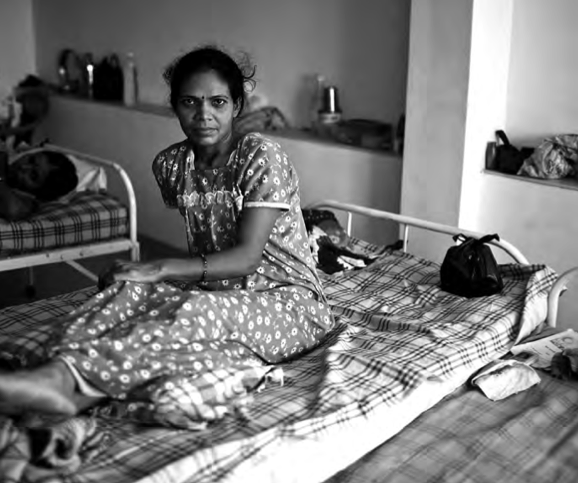
Photo by Sanjit Das (sanjitdas.com)
Like garment workers in sweatshops across the world, women in Bangalore are underpaid and overworked. In order to meet short production cycles set by global market demands, they work at an inhumanely fast pace, with few or no breaks. They frequently suffer from headaches, chest pain, ear and eye pain, urinary tract infections, and other health problems. Sexual harassment and abuse are rampant on the production line. The supervisors, almost all men, castigate women in sexually derogatory terms when they do not meet production quotas, and often grope the women as they instruct them on how to work better. “Sometimes,” says Indirani, “I wouldn’t take a lunch break when pieces piled up. I didn’t want to be shamed in front of everyone. I would go to any length to avoid calling the supervisor’s attention to me.”
Indirani earned $100 to $110 monthly, depending upon her attendance, punctuality, and overtime hours. Frequently, she and her co-workers were unable to meet the inordinately high production targets and were required by supervisors to stay past regular working hours to meet their quotas. “Playing” catch-up, however, did not necessarily result in overtime pay. Indirani’s husband became suspicious if her paycheck did not reflect her overtime hours. He wondered whether she was really at the factory, or whether she was cavorting with another man. Indirani, like many of the women I interviewed, reported that she felt debased at work and at home.
Prior research on Bangalore’s female garment workers suggests that they work an average of 16 hours a day in the factory and at home doing laundry, cooking, taking care of children, and commuting to work. Working in the factory all day, and then returning home to complete household tasks was absolutely exhausting. Indirani’s friend Suhasini, who was also a surrogate mother, avoided garment work altogether. Her mother, sister, and other women family members had worked the line, and she knew it was not what she wanted for her life. “But I need money,” she told me. “For us,” she says, “surrogacy is a boon.” She describes Mr. Shetty who started COTW, as “a god to us.” When I met her again in December 2011, Suhasini was receiving hormonal injections so that she could be a surrogate mother for a second time.
For much of her working life Indirani has been intermittently employed in one of Bangalore’s many garment factories. She quit when pregnant, and joined the line again when her two children attended school. She also stopped factory work when she was sick, or had to care for sick family members. From the perspective of the garment factories, when Indirani is healthy she is a valuable worker for the firm. But during her pregnancies and illnesses, or when she has to attend to her family’s needs, she loses her value as a worker, and the company replaces her. She is, as anthropologist Melissa Wright calls it, a “disposable worker.” Upon recovering her health, or managing family chores efficiently, Indirani cycles back into the garment factory again, this time miraculously having regained her value for the production process. Over her working life, Indirani has shifted from being valuable, to becoming an undesirable worker who must seek other forms of employment to help support her family.
making babies
Indirani and her auto-rickshaw worker husband have struggled for much of their married life to make ends meet, and to support their small children. Indirani’s husband did not earn much money. He rented his vehicle from an acquaintance, and the daily rental and gasoline costs cut significantly into the household income. So Indirani and he decided to borrow money from her cousin to purchase an auto-rickshaw of their own. Their troubles worsened when they were unable to pay back the loan, and the cousin would often arrive at their door, demanding his money and screaming expletives at them. He would come to the factory on payday and take Indirani’s entire paycheck. She said, “I’d work hard, facing all sorts of abuse. And at the end of it I wouldn’t even see any money. I felt so bad I contemplated suicide.” When a friend at work suggested that she sell her eggs to an agency called COTW for approximately $500, Indirani jumped at what she perceived as a wonderful opportunity. After “donating” her eggs, Indirani decided to try surrogacy; she became pregnant with twins on her first attempt.

Photo by Sanjit Das (sanjitdas.com)
Indirani did not find surrogacy to be debasing work. She earned more money as a reproduction worker than she did as a garment worker, and found the process much more enjoyable. She was exhausted physically and emotionally working as a tailor in the factory and then cleaning, cooking, and taking care of her family. Upon getting pregnant, however, Indirani lived in the COTW dormitory. At first she missed her family, often wondering what her children were doing. Was her mother-in-law taking care of them? “I was in a different place surrounded by strangers,” she recalled. But soon she began to like the dormitory. She didn’t have to wake up by 5 am to prepare meals for the family, pack lunches for everyone, drop the children off at the bus stop so they could get to school, and then hop onto the bus herself to get to the garment factory. Instead, she slept in, and was served breakfast. She had no household obligations and no one made demands on her time and emotions. Surrogacy afforded her the luxury of being served by others. She did not remember a time in her life when she felt so liberated from all responsibilities.
surveillance and sisterhood
As she got to know the other women in the COTW dormitory, Indirani began to feel as though she was on vacation. For Indirani and many of the surrogate mothers I interviewed, it was easier to talk with the friends they made in COTW than with childhood friends and relatives; they felt they had more common with one another. Through the surrogacy process, many women told me, they lost a baby but gained sisters for life.

Photo by Sanjit Das (sanjitdas.com)
Noting the closed circuit cameras that monitored the
mothers’ every move in the dormitory, I asked how they felt about them. Indirani said they didn’t bother her; in fact, most of the mothers did not register the cameras’ presence. While this initially surprised me, I soon realized that they were accustomed to surveillance in their everyday lives. Living under the gaze of relatives and inquisitive neighbors, and housed in one-two room homes where it was common for six to eight households to share a bathroom, notions of privacy were quite foreign.Surveillance at the dormitory was benign in comparison to the surveillance and punishment meted out for supposed infractions on the garment shop floor, where long conversations with teammates, taking a few minutes of rest, or going on breaks were all curtailed. In comparison, surveillance at COTW, designed to check on whether the women were having sex with their men folk who visited the facilities, seemed relatively banal.
The surrogate mothers delivered their babies through caesarian surgeries between the 36th and 37th week of gestation in order to conform to the scheduling needs of potential parents. Indirani was initially fearful of going under the knife, but she saw many mothers survive caesarians and was no longer anxious. In the end, she found the caesarian method of delivering the twins she had carried easier than the vaginal births of her own two children.
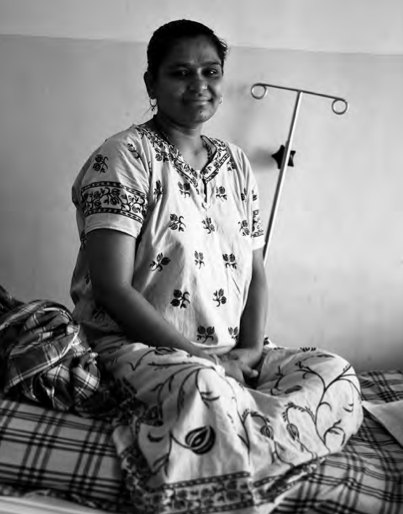
Photo by Sanjit Das (sanjitdas.com)
Indirani claimed she does not feel any attachment to the twins she carried. “They were under contract. I couldn’t bring myself to feel anything for them,” she told me. “They were never mine to begin with, and I entered into this knowing they were someone else’s babies.” It is hard enough for her to take care of her own two children, she said. “Why do you think I’m going through all this now? What would I do with two more? They are burdens I cannot afford.” On the other hand, some mothers professed deep attachments to the babies they had given up. Roopa, a divorced mother who gave birth to a baby girl three years ago, always celebrated her contract baby’s birthday. “June 21st akka,” she said, “I cook a special meal. My daughter doesn’t know why we have a feast, but it’s my way of remembering my second child. I still cry for that little girl I gave away. I think about her often. I could never do this again.”
life out of waste
Regardless of how they felt about the babies they had given up, the women almost all said they derived far more meaning from surrogacy than they did working under the stern labor regimes of the garment factory. In our conversations, time and again, women described the many ways they are deemed worthless in the garment factory. Their labor powers exhausted, their sexual discipline suspect, their personal character under question, they are converted to waste on the shop floor—until they are eventually discarded. On the other hand, Bangalore’s reproduction industry, they said, gave them the opportunity to be highly productive and creative workers once more.
Indirani contrasted the labor processes in producing garments and producing a baby: the latter was a better option, she said. “Garments? You wear a shirt a few months and you throw it away. But I make you a baby? You keep that for life. I have made something so much bigger than anything I could ever make in the factory.” Indirani observed that while the people who wore the garments she’d worked on would most probably never think about her, she was etched forever in the minds of the intended parents who took the twins she bore.
Indirani and the other mothers I met did not necessarily see selling eggs or surrogacy as benign processes. Nor did they misread their exploitation. However, given their employment options and their relative dispossession, they believed that Bangalore’s reproduction industry afforded them greater control over their emotional, financial, and sexual lives. In comparison to garment work, surrogacy was easy.
Surrogacy was also more meaningful for the women than other forms of paid employment. Because babies are life-affirming in ways garments are obviously not, surrogacy allowed women to assert their moral worth. In garment work their sexual morality was constantly in question at the factory and at home. At the dormitory, in contrast, they were in a women-only space, abstaining from sex, and leading pure, virtuous lives.
Through surrogacy, Indirani said, she had built a nuclear family unit and fulfilled one infertile woman’s desire to be a mother. In the process, she had attempted to secure the future of her own family and her own happiness. As a garment worker Indirani felt she was being slowly destroyed, but as a surrogate mother she said she was creating a new world. She was ready to go through surrogacy once again to earn money for her children’s private schooling. The last time we met in December 2011, Indirani asked me, “If anyone you know wants a surrogate mother, will you think of me? I want to do this again.”
recommended resources
Haimowitz, Rebecca and Vaishali Sinha. Made in India (2010). This is a feature length documentary film on surrogacy in India, which explains the organization of the industry through the journey of one American couple to an Indian surrogate.
Pande, Amrita. “Commercial Surrogacy in India: Manufacturing a Perfect Mother-Worker,” Signs(2010) 35: 969-992. This is an account of surrogate mothers living in dormitories in Anand, India.
Teman, Elly. Birthing a Mother: The Surrogate Body and the Pregnant Self. (University of California Press, 2010). The book documents the relationships between straight women and their surrogates in Israel, where assisted reproductive technologies are subsidized for heterosexual couples.
Wright, Melissa. Disposable Women and Other Myths of Global Capitalism. (Routledge, 2006). An anthropological description of how women in the global south are seen as bad workers, and yet their work is crucial to multinational companies’ profits.
Thursday, May 10, 2012


Tuesday, May 1, 2012
Celebrities and Surrogacy!
World of Surrogacy founder says it’s an affordable option for all couples struggling with infertility. http://www.worldofsurrogacy.com
Washington, DC (PRWEB) May 01, 2012
Giulianna & Bill Rancic announced this week that after years of struggling with infertility and a recent breast cancer battle, they are finally expecting a biological child via gestational surrogacy. Click here to see the Today Show clip.
Many other celebrity couples have children through surrogates, including Elton John and David Furnish, Sarah Jessica Parker and Matthew Broderick, and Nicole Kidman and Keith Urban.
Surrogacy isn’t just for celebrity couples, though. All couples struggling with infertility can, in fact, afford to achieve pregnancy via a gestational carrier, just like the Rancics.
Surrogacy can be very expensive in the U.S. with a $100K-plus price tag, but it’s much more affordable in India, where the cost starts at $35K.
WORLD OF SURROGACY
Crystal Travis founded World of Surrogacy, and has become a personal advisor to intended parents. She and her husband, Colin, know firsthand. They are parents of Mark, born in 2008, and twins Alec and Elle, born in 2010. The same surrogate mother at Akanksha clinic in Anand, Gujarat, India, delivered all three of the children.
Crystal has cultivated key relationships in India, and knows the in-and-outs of surrogacy. She would like to share her story with intended parents, and help guide them through the process.
“Every family has the right to realize their dreams of parenthood in an affordable and low stress way,” says Crystal. “World of Surrogacy is committed to that dream by providing guidance, support, and comfort to our clients throughout the surrogacy process, from conception through birth and beyond.”
Crystal is based in Washington, DC, and is available for television interviews on set or via satellite, as well as radio, print and web interviews.
For more information about World of Surrogacy and Crystal Travis, visit http://www.worldofsurrogacy.com.
Tuesday, March 6, 2012
March 2012 --Mark, Elle & Alec
 |
| Alec & Elle, at 14 months! |
 |
| Elle with our week-end nanny looking on. |
 |
| Mark and his favorite blue slide |
 |
| Alec loving the outdoors. |
Thursday, February 2, 2012
Intended Parents Dumps Surrogate Baby & Gets him Back!
--This story is the reason why I preach to intended parents, that they only work with doctors that have a proven track record, and that they have staff or a facilitator to help you through the process---
Green with her baby after passport authorities returned the infant to her. Picture by G Vijayalakshmi
Hyderabad, Jan. 28: An American abandoned her seven-week-old son, born of a surrogate Indian mother, on a bench at the regional passport office here after being refused an Indian passport for the baby so she could take him home.
It was all apparently caused by a misunderstanding, however, and has led to a happy ending.
J. Pearl Linda Van Buren Green, a 35-year-old New Yorker, had not been clearly told that her son, Emperor Kaioyus Van Buren Green, didn't need a passport to leave India.
She later explained she had acted in frustration after spending thousands of dollars over many months in her pursuit of a surrogate baby.Police have decided not to press charges of abandonment, which could have brought Green a jail term of up to three years.
Yesterday, Green was told the foreign ministry had decided to issue an identity certificate for the baby that would act as his travel documents. However, his father Eric Dalton Green, based in Jamaica and a citizen of that country, must first send a letter endorsing his wife's application for the certificate.
Green had arrived in India with seven samples of her husband's semen. After failed efforts in Mumbai and Goa, she came to Hyderabad about 18 months ago. At a fertility clinic here, the child was conceived with eggs donated by a lady from Rajahmundry.
Another local lady acted as the surrogate mother, delivering the child on December 7. Green then applied for a passport for the baby on the Tatkal route.
On Wednesday, she got frustrated when, after a two-hour wait at the passport office and an hour's verification process, she was told the passport could not be issued as the baby was not Indian.
The incident reflects the plight of foreigner couples who have surrogate children in India but whose own countries, lacking surrogacy laws, refuse passports to the babies. After two such children, born to Japanese and German couples, faced such problems in 2008 and 2009, the Supreme Court had shown the way out by directing they be issued identity certificates.
Green was apparently not told about this. After she walked out in a huff, the passport authorities found the baby on a bench in the office waiting room. They went through CCTV footage to ascertain what had happened. From Green's application, they identified the fertility clinic, which gave them the American’s local phone number.
We have asked Ms Van Buren Green to submit an application for an identity certificate for the baby,” regional passport officer K. Srikar Reddy said. I wish things would be cleared soon,” Green told reporters yesterday, adding that she could not afford to stay any longer in Hyderabad because of financial constraints.
Surrogacy has become a big business in Hyderabad and its neighbourhood, causing fertility centres to mushroom over the past five years. Many women from Andhra Pradesh’s drought-hit districts choose to become surrogate mothers to earn a few extra bucks for their impoverished families.
“We get reports of at least 50 to 100 such births in a month,” the state health secretary said. Only about five per cent of the parents are foreigners. “Most of the clients are women from well-to-do Indian families who want to avoid childbirth so that their lifestyle, or body shape, is not affected,” said Srinivas Prasad, a doctor at one of the city’s top 15 fertility centres.
A fertility expert said his centre had a list of “nearly 400 surrogate mothers” who could be contacted at short notice. “We charge about Rs 3-5 lakh per case,” he added. A surrogate mother receives between Rs 75,000 and Rs 1 lakh besides the cost of medicine and maternity expenses.
The same lady is not usually allowed more than three surrogate births but there has been one instance of one lady giving birth to five surrogate children.
Subscribe to:
Posts (Atom)